Leadership Goals
Set goals that connect to how you actually lead
Most leadership goals are set in a performance review and forgotten a week later. Lead-well connects your goals to your weekly reflections — so progress is grounded in what's actually happening, not just what you intended.
The problem
Leadership goals get set — and then quietly abandoned
You set a goal to give better feedback. To be more present in 1-on-1s. To stop being reactive. And then the week gets busy, there's no system to check in on it, and six months later it's back on the list as if it was never there.
Lead-well's Leadership Goals connects your development aspirations to your weekly practice — so every reflection is a data point on how you're progressing, not just how you're performing.
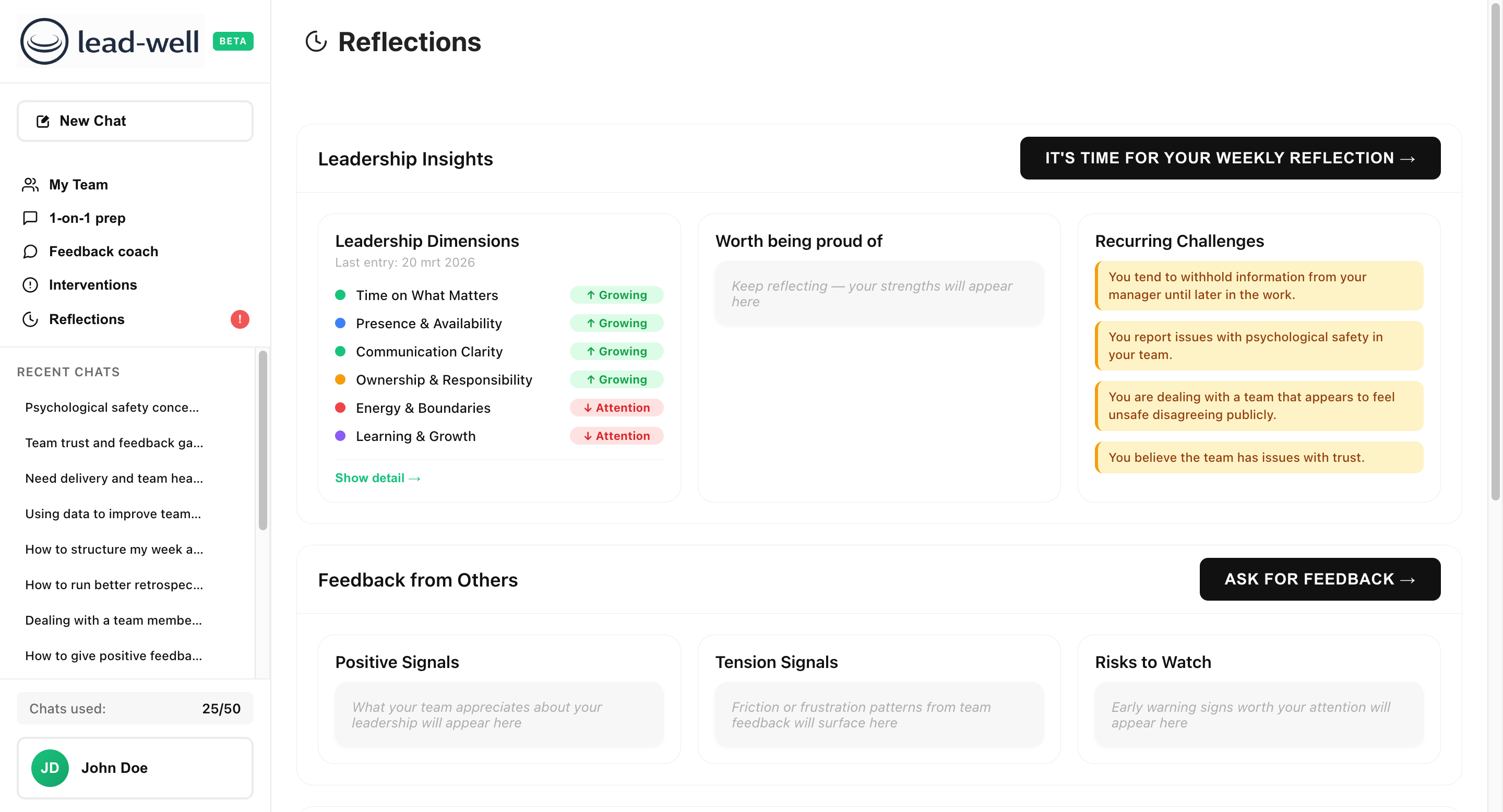
How Leadership Goals works
Set what you want to work on. Let your weekly reflections do the tracking.
Define your leadership goal
Name what you want to work on as a leader — give feedback more directly, be more present in 1-on-1s, stop second-guessing decisions. Your goal, in your words.
Reflect on it each week
Your Leadership Goals appear in your weekly reflection. Each week you check in: did you make progress? What got in the way? What would you do differently?
Track real progress over time
Lead-well builds a private picture of how you're moving toward each goal — grounded in actual reflections, not vague intentions.
What leadership goals actually look like
Not KPIs. Not OKRs. Goals about the kind of leader you want to become.
Give corrective feedback in the moment
Stop waiting for the right time. Name it when you see it — clearly, specifically, and without it becoming a bigger conversation than it needs to be.
Be genuinely present in every 1-on-1
No laptop. No phone. No half-attention. Every 1-on-1 is a full investment in the person in front of you — and they should feel it.
Let your team own the outcome, not just the task
Stop being the bottleneck. Hand over the brief and the method and trust people to get there. Intervene only when it actually matters.
Notice when I go into problem-solving mode too fast
Catch the instinct to fix, and ask one coaching question instead. Let the person find their own answer before offering yours.
Be clearer on the why behind decisions
When you make a call, explain the reasoning. People follow direction better when they understand what's driving it — not just what it is.
Check in on people, not just projects
Start one 1-on-1 per week with a genuine 'how are you?' — and actually wait for the answer before moving to the agenda.
Leadership Memory
Your goals stay alive because your reflections feed them
Leadership Memory connects everything. Your goals aren't a separate list that lives in a notes app and quietly dies — they're woven into the rhythm of your weekly practice. Each reflection is an honest check-in on whether you actually moved toward what you said you wanted to change.
Over time, this builds a private picture of your leadership development — where you've genuinely grown, where you keep getting stuck, and what conditions make change possible for you.
Goals connected to reflections
Every weekly reflection checks in on your active goals — so they're a living part of your practice, not a forgotten document.
Progress that reflects reality
Progress is measured in actual check-ins, not self-reported estimates. You see what you did, not just what you planned to do.
Patterns that surface over time
After several weeks, you can see which goals are moving, which are stalling, and what consistently gets in the way.
Completely private
Your goals and progress are visible only to you. Lead-well is a private thinking space — there are no team dashboards or HR reports.
"The goal didn't change. What changed was that I stopped pretending I was working on it and started actually tracking whether I was."
Early user — Head of Product, scale-up
Common questions
How are leadership goals different from performance goals?
Performance goals are about outputs — hitting targets, delivering results. Leadership goals are about how you show up in the role: how you communicate, how you develop people, how you handle pressure. Lead-well is designed for the second kind — the ones that don't appear in OKRs but shape everything about how your team experiences you.
How many goals should I set at once?
One to three. More than that and the weekly check-in becomes noise rather than signal. The goal of leadership goals in Lead-well is genuine development, not a comprehensive self-improvement plan. Pick the one or two things that would most change how you lead right now.
How does Lead-well track progress on my goals?
Each week, your active goals appear in your weekly reflection. You check in honestly on whether you made progress, what got in the way, and what you'd do differently. Over time, Lead-well builds a picture of your trajectory — including patterns in what helps and what consistently blocks progress.
What if I want to change a goal mid-way through?
You can update or archive a goal at any time. Leadership development isn't linear — you might discover that the goal you set wasn't quite the right one, or that it needs to be reframed. Lead-well is a private space for honest work on your leadership, not a contract you have to honour at all costs.
Start working on the leader you want to become
Free to start. No credit card. Private by design.